SIGN THE PETITION HERE
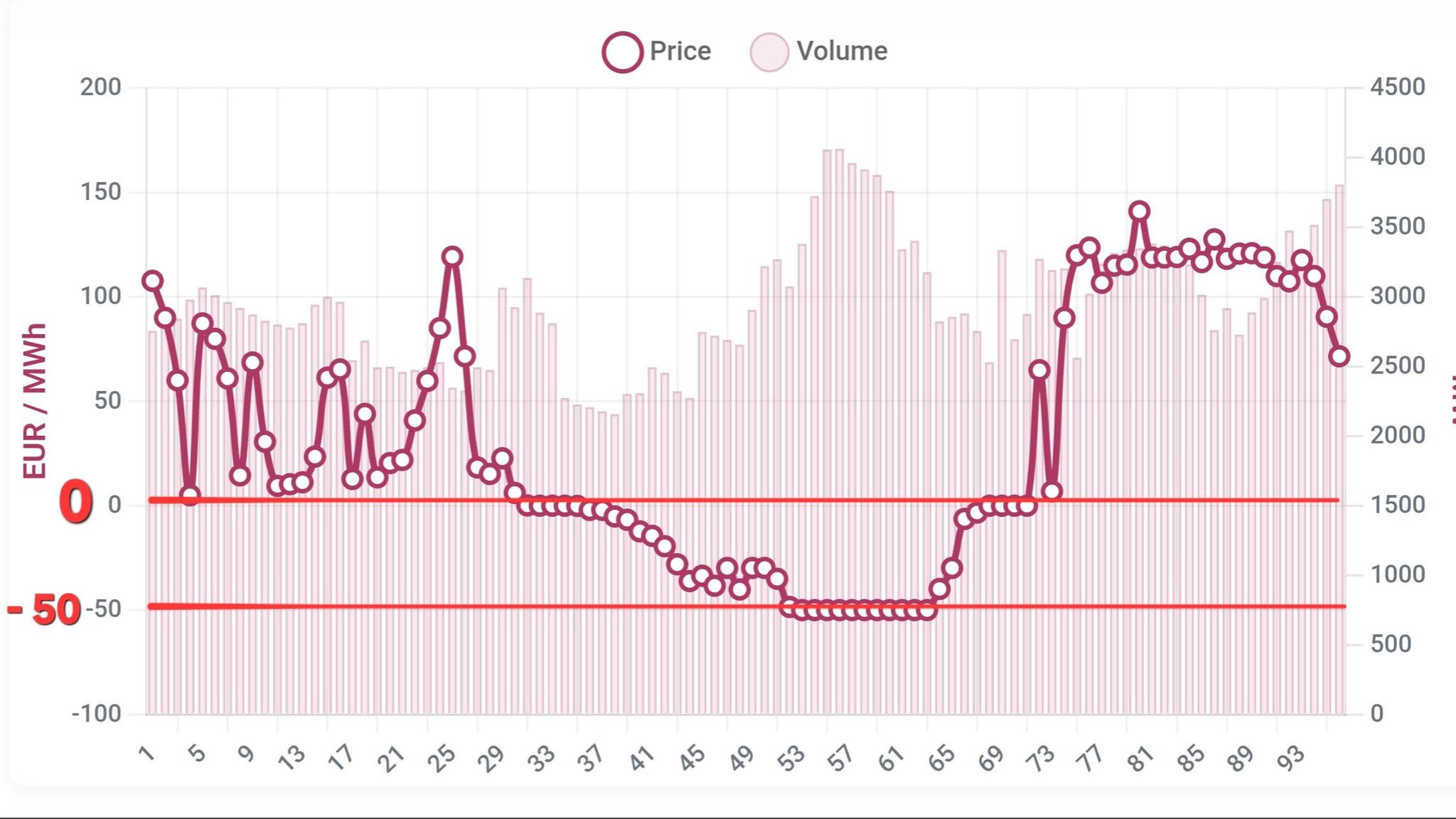
Graph of electricity exchange prices in Bulgaria, as obtained every Saturday and Sunday on sunny days
Presentation by Svetoslav Proinov, coordinator of the civic initiative for the Maritsa-east complex
video of the presentation:
https://www.youtube.com/watch?v=s8Xtj9tljbQ
text version of the presentation:
The ENTSO‑E report from 9 June 2026 confirms exactly what our engineers warned about three months earlier.
The report explicitly states that the withdrawal of conventional, dispatchable power plants reduces system flexibility, while new renewables lack the technical capability to provide the same stability services – inertia and voltage control.
It also highlights “market games” (inc‑dec gaming) – speculation with batteries, artificial price spreads during the day, and massive balancing costs that ultimately drive up electricity prices for households.
Let me give you a concrete example from Bulgaria. Every Saturday and Sunday, when industrial demand is low, solar panels generate over 1,000 MW during peak sunlight hours. Exchange prices drop to zero – or even negative. At these prices, large battery owners charge their systems for 2‑3 euros per MWh. Then, in the evening, when demand peaks and prices jump to 135 euros, they discharge the same electricity.
That is a profit of over 130 euros per MWh – at the expense of consumers and the entire system.
And how were these batteries financed? With carbon tax money extracted from the Maritsa‑East complex. That money flows through the Security Fund and EU mechanisms (formally as EU policy), only to be returned to a few selected private renewables investors. They buy batteries and solar plants with that money, and then they speculate.
Meanwhile, small solar producers – over 30,000 installations in Bulgaria – are going bankrupt. They cannot afford batteries, because batteries add 20‑25 euros per MWh to the cost of electricity, making them unprofitable for any real private investor. Batteries are only profitable for those who buy them with money extracted from the Maritsa‑East complex. In Bulgaria, flexible loads and DC grids are completely absent. While in the rest of the world renewables and batteries are deployed in symbiosis with Large Flexible Loads and DC systems, in Bulgaria no such symbiosis exists! That is why batteries and solar parks are unprofitable for ordinary private entrepreneurs.
This is why we demand immediate derogation – a temporary suspension of carbon taxes – until a permanent European compensation mechanism for system services is established.
Without such a measure, the flow of funds to these speculators will continue. With a derogation, the three large TPPs will become competitive again, TPP‑1 and TPP‑3 will be restarted, and the entire mining sector will be stabilised.
We are not against the green transition. On the contrary. We are against its perversion and corruption.
At this moment, a few specially selected businessmen are building huge solar parks, cutting down centuries‑old forests and destroying mountain ecosystems. At the same time, tens of thousands of small solar installations – which account for almost 40% of the country’s installed capacity – cannot operate and are going bankrupt in large numbers.
Our demands are fully aligned with the TEN‑E Regulation and with ENTSO‑E recommendations. We want to preserve the infrastructure that ENTSO‑E itself identifies as critically important for the stability of the grid in Southeast Europe.
The solution is not to shut down coal prematurely. The solution is to combine renewable energy with large flexible loads – data centres, high‑performance computing, and industrial loads that can absorb excess energy when production exceeds demand.
This is not theory. This is standard practice in the USA, France, Germany, Spain, Finland, Canada, and many other countries. It is also a key recommendation in the ENTSO‑E report.
This is the real opportunity. Keeping Maritsa‑East as a strategic energy node is not about preserving coal – it is about preserving critically important grid stability in Southeast Europe.
Because if Brussels does not recognise Maritsa‑East as a system service provider now, it will soon have to pay ten times more to rebuild the stability that this complex is already providing to the grid in Southeast Europe.
If you believe this issue deserves a professional European debate, we would be glad to share our technical proposal and invite you to join the discussion. Links to the technical document and the petition are in the first comment.
This is part of the coordinator's presentation at the Energy Discussion Forum in Bulgaria on 13 June. It received approval from all attending experts and members of parliament. At the end of the discussion, the participants agreed that the complex is important and necessary not only for Bulgaria but also for the grid stability of the region.
Related materials:
Stara Zagora, June 13, 2026. Discussion forum of power system
ENTSO-E June 2026 Report Confirms: The Physics of the Grid Cannot Be Ignored
 The Physics of Grid Stability: Why Europe cannot afford to miscalculate synchronous inertia
Can Southeast Europe’s largest energy complex solve the EU’s grid stability crisis?
A Technical Proposal for EU Grid Stability
SIGN THE PETITION HERE